
I feel that it is important for me as a professional and human who always felt calling in writing and researching and understanding to address my motives for this blog/account going forward. It has been few years now since I have started therapeutic practice and I gained a lot of insight and experience, but of course much much more to come in future years. I recognise that my training and work with clients shaped me to the professional and human I am today and I would like this to reflect here as well. At the beginnings I was trying to find my place within this field now I am starting to be shaped into a certain directions within the field, which reflect who I am as a human. One of the main goals of therapy is to help people become their true version of themselves aka. Themselves and so I am doing the exact same following a direction reflecting who I am.
First focus I would like to have here is..
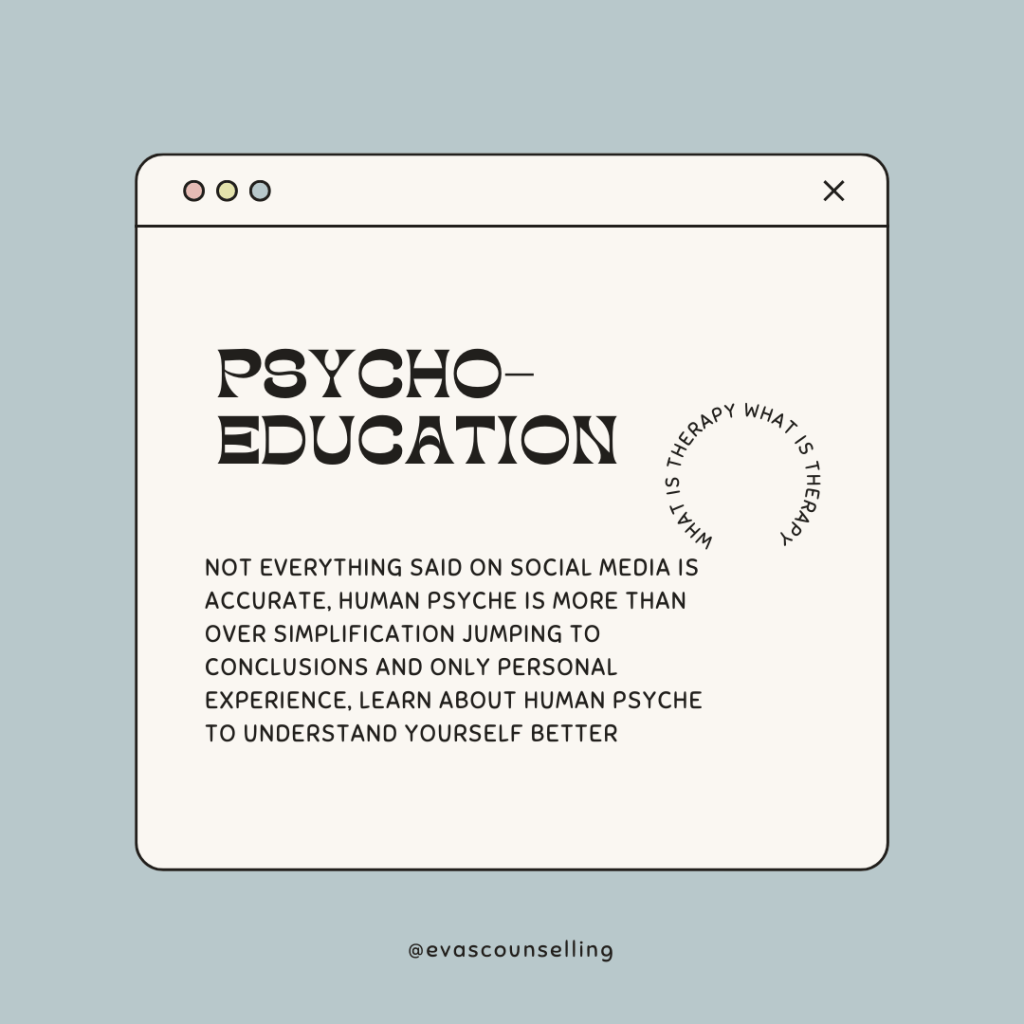
What I have seen a lot in clients who I have worked with past few years is often little understanding of aspects of our psyche and how big role this play in their everyday lives. It is absolutely normal and common and I have been there myself before I set on a journey of psychotherapy, but I recognise as well a need for psychoeducation out there. There is a lot of great therapists and professors and educators pitching their bit of knowledge into the world, but as not every therapist will fit to every client, not every information might be received same way. Not to mention how much misleading information is out there, but we get there. Here comes my corner of a psychotherapeutic knowledge and experience.
The way I would like to structure this blog and what might come with it is bring psychoeducation on the table in the time of very diverse and often misleading information pool out there due to social media and internet. I often come across with snippets of psychology or terms used in wrong situations or jumping into conclusions about others people experiences. I often recognise these to be misleading or used by people without formal education or solely based on personal experience. Here I am not trying to say, that personal experience is not valuable, it is and sharing it brings valuable topics on a public table. What I am trying to offer is a possibility for critical thinking and understanding that if something worked for one person does not necessarily means it will work for you. Same to be said about what one person recognise as their views on life and experiences doesn’t mean it apply same way at yours.
I recognise it is a learning journey and there is not inherently something wrong with sharing personal experiences – it brings very valuable topics out into the open, but the issue is that often people use these experiences and little knowledge they might have as a building stone to create paid courses and become gurus and coaches, unsupervised and not abiding any ethical ethos. I am not talking about valuable life long experiences in different fields combining with maybe professionals from therapeutic realms, but rather gurus and coaches claiming to have a magic answer to your problems when in fact they are using the vulnerabilities of people for personal gain. This I find highly problematic.
Not only one client would share certain image of themselves based on what social media portraits to be a narcissist, what social media portraits as desired life style or what social media portraits as happiness and success. And as we worked through therapy together there were no signs of narcissism other than ones we all have and carry within, meaning these people were completely average people, but social media would make them believe they must be narcissist because they recognized some narcissistic traits within. We all have them but it is a spectrum and having narcissistic traits does not make us having a disorder. As we worked through therapeutic process we would find out that in fact desired lifestyle portrayed by social media does not resonate with a person and they in fact desire something very different for their life. As we worked through therapy they would find out that success and happiness claimed by one person to be ultimate one everyone should thrive for on social media was in fact in absolute disconnection to what success and happiness means in the core for them.
I am not sure at this point how exactly I want to structure and handle this, but I certainly feel it to be present in my work and environment past few years.
Second focus would be…
More and more I work in psychotherapy field more and more I am aware how three simple things in our everyday life have massive impact on our mental health – sleep, food, exercise and sense of adventure.
The last one specially sparks a sense of passion within as I love outdoors and over course of my life I have always seen benefits in stepping out of my own comfort zone into unknown and having the sense of adventure present. I won’t lie I overdone it at times and jump too soon too far or I had period of time in comfortable and safe, but as more I work within the field and getting to know myself I recognise how much adventure plays role in my own mental health, how much outdoors plays in me feeling grounded within myself and being able to show up in constructive way for not only people in my life but as well and specially for clients.
Theme of adventure, stepping out of a comfort zone, outdoors and connection with nature is something I feel strongly passionate about and would like to connect as much as possible with my therapeutic approach. I believe that part of this passion is based on seeing raising disconnection with nature in the society and raise of mental health issues as an outcome of that. Only in past few decades we disconnected and moved into indoors to almost 100% in some cases than ever before in thousands years. Our bodies and their genetic propositions passed on through generations are equipped to function mostly as hunted-gatherers did because that is the most chunk of time we experienced in the whole life span of humankind. Such a quick turn around of settling down becoming farmers within thousands years and then into industrial age and now technological only in decades is something our bodies are not entirely equipped to cope with, because of such a rapid way it all happened. Only industrial and technological era happened within couple of centuries.
That being said another theme I would like to focus on here is outdoors and sense of adventure in connection to our mental health. Outdoor adventures offer simplicity of life and I believe this is something strongly tithed to our ancestral upbringing as human kind, which we find comforting and where we find skills within we forgot we had, but often need to be used in our lives to feel connected and grounded within.

Third and last focus would be…
The best is left for the last. Art and creativity has been present in my life profoundly in past decade. In fact I believe art saved my life and fact I was brought by some inner voice and wisdom to painting was curtail event to become my authentic true self. It has not been easy and I had breaks inbetween due to circumstances and very limiting believes passed on to me, but I can say today that art has been my way of relating to the world and searching a connection with it. Creativity and art itself helped me to be authentic and real in an inauthentic world and this is something what informs my therapeutic practice.
I won’t lie it has not been an easy path and I am still not where I would like to be when comes to my artistic pursues, but I see it as a lifelong journey. At times I am not creating I recognise my mind still thinks creatively, observing world around. At times I create I enjoy the flow.
Saying that creativity is a big part of my therapeutic approach. It doesn’t always mean that I use artistic tools in therapy, in fact I often don’t, but the way I work with clients is relational and is creative. I have noticed that therapy works best if I let it happen and so does art. I have heard many artists over the years expressing how their paintings happened to appear on a canvas. When I paint even though I use certain tools for painting, it as well appears on the paper often without me knowing how. Therapy is somewhat similar process. It seams as a lot of unrelated pieces specially at the beginning and as we move through the process, different themes and different topics come to the surface until it eventually comes all together in the form of self-awareness. As much this sounds as artistic process in fact it is not and can be suitable for everyone even if not artistic at all. There are different forms of therapy and if you prefer structure, following step by step approach the way I work might not be suitable for you and you might need a different kind of therapist.
I would like to share here creative process and connection to therapy, somewhat outside of the box sometimes, less walked by professionals and possibly less backed in research, but yet proven through mine or other’s therapists practice to be working and valuable. Research in therapy might be in fact another theme and topic I’d like to bring light onto as there is a trend nowadays pushing forward certain one approach to therapy which is heavily funded and so researched, but doesn’t necessarily mean that is better approach than ones less funded and researched with long tradition in therapeutic practice.

All these said I hope you will find here around something relatable and of course if not it is absolutely fine if you move on elsewhere.



 evasartherapy.blog