Do we have to celebrate Christmas?

Stress.

Exhaustion.

Overwhelm.

These would be certainly most common feelings I would hear from clients or experience myself in months leading towards Christmas and even once they arrive. Christmas is a beautiful time of the year, joyful and merry for many.

BUT.

For many it is time of sadness, remembering people we lost, time of stress and overwhelm from pressure Christmas creates for us financially, emotionally and mentally by the sudden energy and effort and resources we often don’t have and we need to put into buying or creating presents. Everyone on high alert and stressful energies gathering together with families when these stresses are released and people argue, blame and often forget about what the whole Christmas were meant to be about. Not talking about those who might not have anyone to celebrate with and whole Christmas is a reminder of their own loneliness.

Imagine how we would approach each other if we’d decide not giving each other presents or if we decide we won’t come to visit or we won’t make big meals?

For many this would create even more sad feelings, because Christmas are meant to be about celebration about gathering together about giving presents because we care about each other. Managing opposing ideas and wishes within groups of people can be difficult as one might be okey with not giving presents within entire family inbetween each other meaning it in the best possible intention – to reduce stress for everyone, but a family member or a friend might see it as they don’t care enough about the relationship if they can’t even think of giving a present, visit or cook big meal.

I would be curious if the answer is somewhere in the middle, if it is about recognising what we need and how we can fit this within others or if it is even possible. Maybe there’s place to have conversations about Christmas presents if this is too big of a restrain on us, maybe it is having conversations about visits, if we want to have a quiet time within small family or inbetween partners only, maybe it is having conversation about cooking duties and how much can be done and for how many people.

And ultimately if it feels too much, too stressful or too overwhelming it is okay to not celebrate at all as well. Many years ago I couldn’t even imagine not celebrating Christmas, but there are actually many people out there who don’t and it is same valid because this is the way it works best for them.

Bringing such ideas within specially family can be difficult and you might be met with no understanding. Possibly approaching it from compassionate place where you understand this might be painful in some way for them, reassuring them that your relationship towards them is still the same, but you just find it too much at the moment, might be one of the ways going about it.

Sometimes we get so caught up in our own ideas and how we consider world to work best, that we don’t allow needs of other people to come forward, we stop being open to different possibilities and realities other people might be living in. I get it and certainly I’ve been guilty of such many times. It is after all how our brains work, we have a ‘blind spot’ towards ourselves where we can’t see ourselves just the way we are. It’s quite human in fact. But especially when other realities are just so alienated to ours this might ultimately mean that these relationships might not survive and carry on, at least not in connected genuine way, because we are just way too different people. It might all lead to acceptance of others people realities, acceptance of the dynamic it creates and even acceptance of possible end. But here I am going to a completely different topic possibly for another day.

As a society in countries celebrating Christmas we jump on the whole Christmas roller coaster either we want to or not because it is expected of us. Some of us really enjoy this time period and some of us would rather not to celebrate at all and both options are equally valid. If you want to celebrate, please do by all means, but if you don’t, please do by all means as well.

This one is a bit different one to previous articles, but as it is Christmas and there is so much of cheering I felt that it might be important to speak towards those who feel the overwhelm this holiday creates helping you allowing yourself to be just you within the pressure. Allowing yourself to take care of your own needs and practice self-care. Allowing yourself to listen to your body and take on board what it has to say.
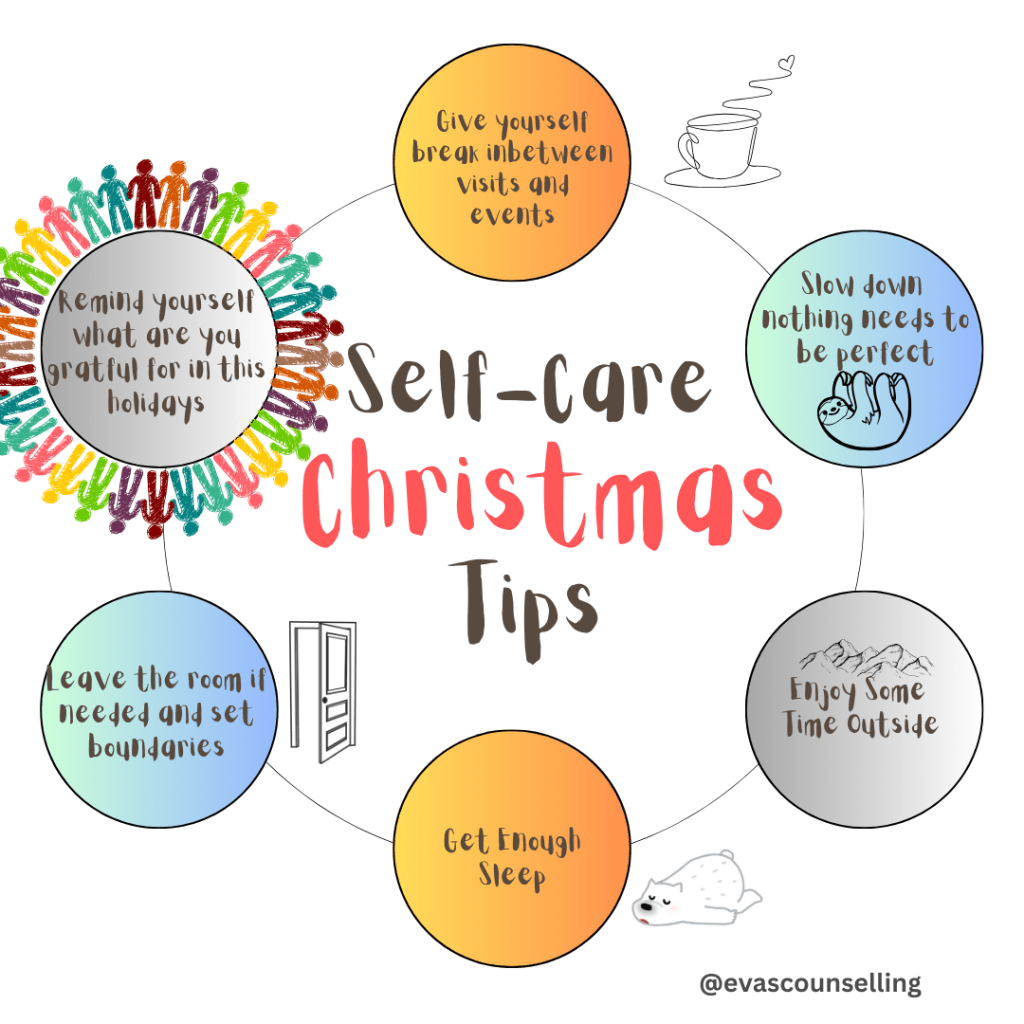
In all honesty I am one learning exactly that myself. It is not a sprint but a marathon, where we sometimes go and are not yet able set appropriate boundaries neither we are able to not get into arguments. It is okay. It is a trying pool where we can observe where we stand.

So I wander do you celebrate Christmas?

Do you enjoy this festive season or does it bring up mostly negative feelings for you?

How are boundaries working for you in this season?

Where am I and this website going from now on…

I feel that it is important for me as a professional and human who always felt calling in writing and researching and understanding to address my motives for this blog/account going forward. It has been few years now since I have started therapeutic practice and I gained a lot of insight and experience, but of course much much more to come in future years. I recognise that my training and work with clients shaped me to the professional and human I am today and I would like this to reflect here as well. At the beginnings I was trying to find my place within this field now I am starting to be shaped into a certain directions within the field, which reflect who I am as a human. One of the main goals of therapy is to help people become their true version of themselves aka. Themselves and so I am doing the exact same following a direction reflecting who I am.  

First focus I would like to have here is..

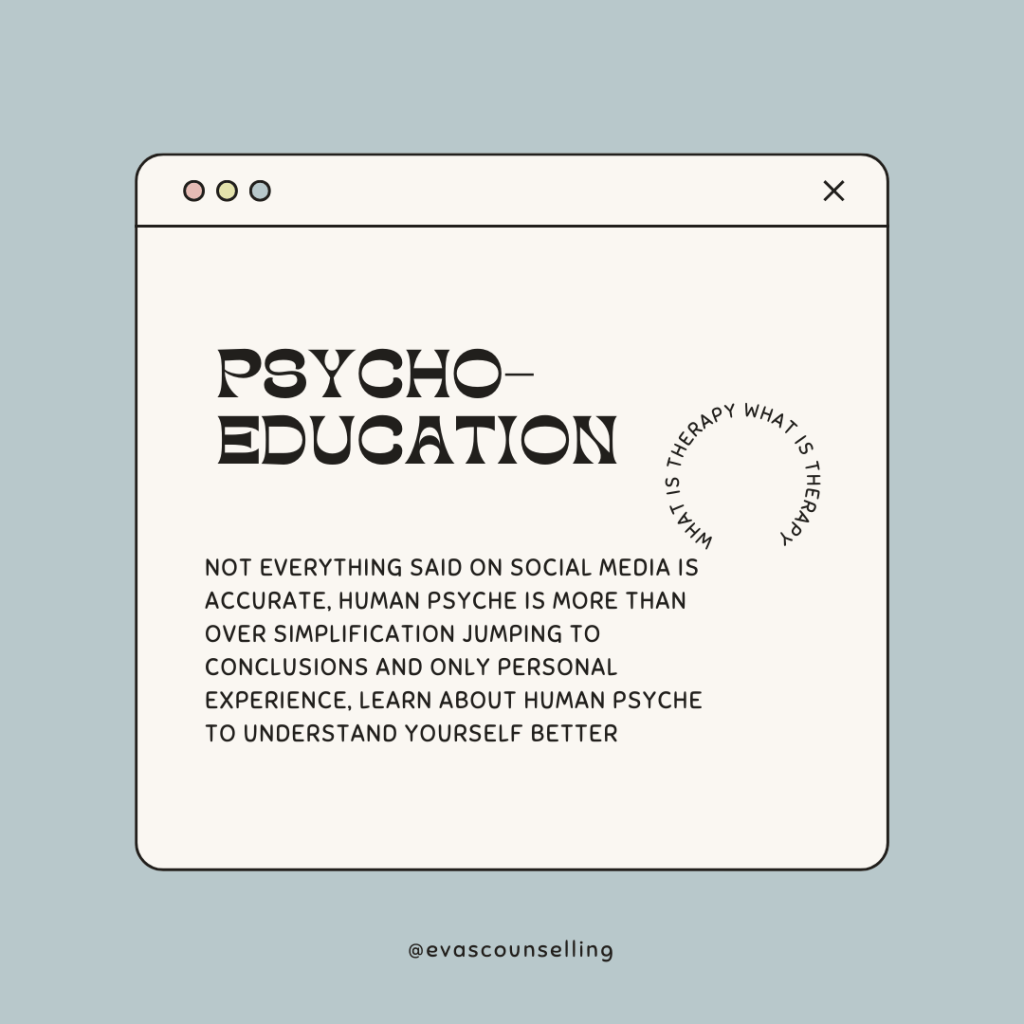
What I have seen a lot in clients who I have worked with past few years is often little understanding of aspects of our psyche and how big role this play in their everyday lives. It is absolutely normal and common and I have been there myself before I set on a journey of psychotherapy, but I recognise as well a need for psychoeducation out there. There is a lot of great therapists and professors and educators pitching their bit of knowledge into the world, but as not every therapist will fit to every client, not every information might be received same way. Not to mention how much misleading information is out there, but we get there. Here comes my corner of a psychotherapeutic knowledge and experience.

The way I would like to structure this blog and what might come with it is bring psychoeducation on the table in the time of very diverse and often misleading information pool out there due to social media and internet. I often come across with snippets of psychology or terms used in wrong situations or jumping into conclusions about others people experiences. I often recognise these to be misleading or used by people without formal education or solely based on personal experience. Here I am not trying to say, that personal experience is not valuable, it is and sharing it brings valuable topics on a public table. What I am trying to offer is a possibility for critical thinking and understanding that if something worked for one person does not necessarily means it will work for you. Same to be said about what one person recognise as their views on life and experiences doesn’t mean it apply same way at yours.

I recognise it is a learning journey and there is not inherently something wrong with sharing personal experiences – it brings very valuable topics out into the open, but the issue is that often people use these experiences and little knowledge they might have as a building stone to create paid courses and become gurus and coaches, unsupervised and not abiding any ethical ethos. I am not talking about valuable life long experiences in different fields combining with maybe professionals from therapeutic realms, but rather gurus and coaches claiming to have a magic answer to your problems when in fact they are using the vulnerabilities of people for personal gain. This I find highly problematic.

Not only one client would share certain image of themselves based on what social media portraits to be a narcissist, what social media portraits as desired life style or what social media portraits as happiness and success. And as we worked through therapy together there were no signs of narcissism other than ones we all have and carry within, meaning these people were completely average people, but social media would make them believe they must be narcissist because they recognized some narcissistic traits within. We all have them but it is a spectrum and having narcissistic traits does not make us having a disorder. As we worked through therapeutic process we would find out that in fact desired lifestyle portrayed by social media does not resonate with a person and they in fact desire something very different for their life. As we worked through therapy they would find out that success and happiness claimed by one person to be ultimate one everyone should thrive for on social media was in fact in absolute disconnection to what success and happiness means in the core for them.

I am not sure at this point how exactly I want to structure and handle this, but I certainly feel it to be present in my work and environment past few years.

Second focus would be…

More and more I work in psychotherapy field more and more I am aware how three simple things in our everyday life have massive impact on our mental health – sleep, food, exercise and sense of adventure.

The last one specially sparks a sense of passion within as I love outdoors and over course of my life I have always seen benefits in stepping out of my own comfort zone into unknown and having the sense of adventure present. I won’t lie I overdone it at times and jump too soon too far or I had period of time in comfortable and safe, but as more I work within the field and getting to know myself I recognise how much adventure plays role in my own mental health, how much outdoors plays in me feeling grounded within myself and being able to show up in constructive way for not only people in my life but as well and specially for clients.

Theme of adventure, stepping out of a comfort zone, outdoors and connection with nature is something I feel strongly passionate about and would like to connect as much as possible with my therapeutic approach. I believe that part of this passion is based on seeing raising disconnection with nature in the society and raise of mental health issues as an outcome of that. Only in past few decades we disconnected and moved into indoors to almost 100% in some cases than ever before in thousands years. Our bodies and their genetic propositions passed on through generations are equipped to function mostly as hunted-gatherers did because that is the most chunk of time we experienced in the whole life span of humankind. Such a quick turn around of settling down becoming farmers within thousands years and then into industrial age and now technological only in decades is something our bodies are not entirely equipped to cope with, because of such a rapid way it all happened. Only industrial and technological era happened within couple of centuries. 

That being said another theme I would like to focus on here is outdoors and sense of adventure in connection to our mental health. Outdoor adventures offer simplicity of life and I believe this is something strongly tithed to our ancestral upbringing as human kind, which we find comforting and where we find skills within we forgot we had, but often need to be used in our lives to feel connected and grounded within.

Third and last focus would be…

The best is left for the last. Art and creativity has been present in my life profoundly in past decade. In fact I believe art saved my life and fact I was brought by some inner voice and wisdom to painting was curtail event to become my authentic true self. It has not been easy and I had breaks inbetween due to circumstances and very limiting believes passed on to me, but I can say today that art has been my way of relating to the world and searching a connection with it. Creativity and art itself helped me to be authentic and real in an inauthentic world and this is something what informs my therapeutic practice.

I won’t lie it has not been an easy path and I am still not where I would like to be when comes to my artistic pursues, but I see it as a lifelong journey. At times I am not creating I recognise my mind still thinks creatively, observing world around. At times I create I enjoy the flow.

Saying that creativity is a big part of my therapeutic approach. It doesn’t always mean that I use artistic tools in therapy, in fact I often don’t, but the way I work with clients is relational and is creative. I have noticed that therapy works best if I let it happen and so does art. I have heard many artists over the years expressing how their paintings happened to appear on a canvas. When I paint even though I use certain tools for painting, it as well appears on the paper often without me knowing how. Therapy is somewhat similar process. It seams as a lot of unrelated pieces specially at the beginning and as we move through the process, different themes and different topics come to the surface until it eventually comes all together in the form of self-awareness.  As much this sounds as artistic process in fact it is not and can be suitable for everyone even if not artistic at all. There are different forms of therapy and if you prefer structure, following step by step approach the way I work might not be suitable for you and you might need a different kind of therapist.

I would like to share here creative process and connection to therapy, somewhat outside of the box sometimes, less walked by professionals and possibly less backed in research, but yet proven through mine or other’s therapists practice to be working and valuable. Research in therapy might be in fact another theme and topic I’d like to bring light onto as there is a trend nowadays pushing forward certain one approach to therapy which is heavily funded and so researched, but doesn’t necessarily mean that is better approach than ones less funded and researched with long tradition in therapeutic practice.

All these said I hope you will find here around something relatable and of course if not it is absolutely fine if you move on elsewhere.

MAKING UNCONSCIOUS CONSCIOUS

For therapists and mental health professionals is subconscious mind fascinating place, source of who we are, what drives us. One of the purposes of therapy is to help us bring subconscious into consciousness.

You might ask why would we want to do that?

Because once subconscious becomes conscious we can decide what we want to do with it, change patterns of our behaviour and decide if how we function, how subconscious drives us functioning serves us or not anymore. Very often we run on autopilot and our autopilot drives believes we have within us about ourselves, about others, about the outside world. We can be reactive or hold strongly negative emotions towards someone/ourselves or the opposite we might feel very connected and close to someone else. Therapy helps to understand these connections and the believes we hold. Sometimes these are creating negative feeling within us and standing in our way, making our life miserable. To understand where our emotions and feelings are coming from we need to understand ourselves and bring some of the unconscious into awareness.

Sometimes this can be painful process, because often our believes are tighed with emotions, which are stored in our bodies for every time we were not allowed to express them. As we start discovering things about ourselves these emotions start to be released and we need to feel them.

Therapy is a place where thanks to bunch of therapeutic tools and a therapeutic relationship these can be released and if needed brought into consciousness in a safe paced manner. There are different types of therapy for different issues, not every therapeutic process works this way as relived past experiences can be sometimes harmful or unnecessary and different direction in therapy is needed.  

Once they are felt they leave our body and won’t drive our autopilot anymore. This might mean that what once you believed about yourself, for example that you are a bad person, because someone told you such thing in the past and you hold them very high (for example a parent, teacher etc.) can be reframed. This believe entered your consciousness, you felt the emotions related to it and now you can reframe the believe to your benefit. This can be done through finding evidence when you were actually a good person. This evidence helps you to reframe believe about yourself.

But that is another story for another day.

In order to begin ‘reframing’ process firstly we need to find out what the believes are. One of the great tools for doing so is intuitive drawing with a purpose. In this article I would like to explain you how to use ‘house floor plan drawing’ as an intuitive symbolic tool to uncover some unconscious believes.  

What you need:

Pencil

A4 paper

Some coloured pencils (optional)

What you do:

Draw a floor plan of your house. This house needs to have 4 rooms – physical, mental, emotional and spiritual room. Now think what is your house like? Draw a floor plan of the house. How many floors are there? Is there a playroom? What rooms apart of the 4 are there?

Once you are done drawing the rooms make a speech bubble for each room and think about what is the purpose of the room, what is inside, what you do inside of each room. Add any objects into the room if you feel as they need to be there.

Don’t read farther until you are done with the exercise!

Unless we go to every room every day even if keep it aired we are not complete person. Is there a room in your house where you live most? How do you feel about it? Is there a room you don’t visit much or never? How does that make you feel? If you have more then one floor are these connected with stairs or somehow? If not how does that feel, why do you think there is disconnection to the rest? If you put playroom in where is it positioned? Is there access from everywhere in the house or just one entrance? Do your rooms have any doors and windows? Is there a hall way? How do the rooms connect to each other? Are there any empty unused spaces? Is there any cupboard and storage? If so how do they make you feel?

Now after thinking about this all…

What would be a title for the floor plan?

Thinking about the process of creation your floor plan you are learning something about yourself. The floor plan represents you and each room is part of yourself. If there are any disconnections you are now aware of them and can start slowly changing it.

If you look at the floor plan now is there anything you would like to change or add?

Once you are done think about how this exercise made you feel? Are there any emotions what need to be felt? What do they connect to? Did your mind wander somewhere? Into any memories while drawing?

Let me know if you learnt anything about yourself doing the exercise? Of course if you feel like you want to share publicly in the comments.

What Masquerade mask revels about you (2. part)

Here comes second part about Masquerade masks. Read this article only if you have done your mask already or you are not interested in the meaning of completed mask.

In this article I am going to mark some main symbols and what to look for once your mask is finished to understand what your subconscious is trying to tell you. Before that I need to tell you one important thing…

IMG_2035

Continue reading

What masquerade mask revels about you? (part 1.)

Looking back I think I was going through some rough times. No aspiration at work, environment felt very hateful, emotionally dried and tired. Does it sound familiar to you?  My world was falling apart and only bright light was craft workshop I was going to on Saturday.

Mindful crafts.

Ideas I could use in my youth work. Workshop ´mindful crafts for children´ happened to be therapeutic session for myself.

First crafty idea was masquerade mask. I remember that day I came home relaxed and fulfilled. I did finally something meaningful for myself.

IMG_2035

When use this craft making?

You can use this therapeutic craft whenever you want and feel. It is great way how to relax and cope once you feel anxious. It can help you to stop overthinking and just be present in the moment. It is great when you feel no motivation, sadness because again it takes your focus to something creative and away from your thought process.

It makes you present.

You can use it as tool to better understand yourself because the way you create your mask will let you uncover a little bit more about yourself. This step is not necessary though because process of making the mask is much more important.

Continue reading